In the Guest Seat: What I'm Seeing in Manufacturing — and Inside Centerline
This month the tables are turned on Maintenance & Manufacturing Insights. Instead of interviewing someone else, I take the guest seat to talk about what I'm seeing in manufacturing, how Centerline works in microns, why OEM parts matter, and a current repair on a spindle that weighs more than 4,000 pounds.
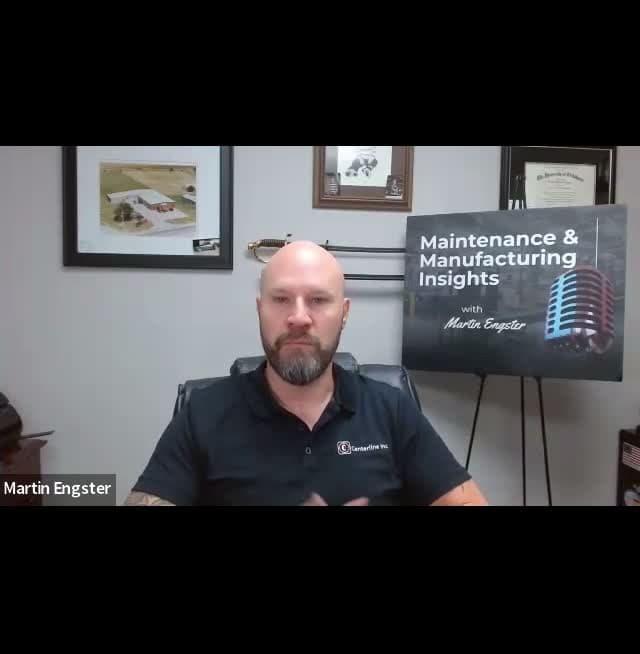
This month the tables are turned on Maintenance & Manufacturing Insights. Instead of interviewing someone else in the industry, I took the guest seat to share what I'm seeing in manufacturing and what's happening inside Centerline.
What I'm Seeing in Manufacturing
Talking with manufacturers, machine builders, and vendors at recent machine tool shows in Chicago — including IMTS, one of the largest in the world — I kept hearing the same thing: companies are bringing production back to the United States. From where I sit, that's good news for the industry.
For a repair facility like ours, though, the impact doesn't always show up right away. New machines usually come with warranties, and those machines need time in service before the repair work starts to follow. So there can be a real delay between growth on the factory floor and growth at the repair shop. It's one reason I pay attention to what manufacturers and machine builders are doing — what's busy today can tell us what's coming months down the road.
What Centerline Does
Centerline runs on three main legs: CNC spindle repair — our core, day-to-day work — plus precision part manufacturing and on-site taper grinding.
The part manufacturing started because we needed parts for our own repairs. Like with an older car, sometimes a spindle is old enough that the replacement part isn't easy to find, so we reverse engineer it and make what we need. Eventually we opened that up to outside customers too.
The common thread is precision. We regularly work within tolerances of 2 to 5 microns. For comparison, a human hair is about 100 microns. Something can look perfect to the eye and still be out of tolerance for the job — when the measurement is only a few microns, every detail matters.
Why OEM Parts Matter
Who repairs your spindle matters, but so do the parts they put inside it. We've opened spindles and found a mix of parts — even bearings installed backward. The problem doesn't always show up on that first repair. If the spindle later has a bigger issue and goes back to the manufacturer, they open it up and see what was done, and trying to save money earlier can get expensive.
I understand the temptation to find a cheaper or faster fix when a machine is down. But putting a band-aid on a broken bone doesn't really solve the problem. A repair should fix what's actually wrong — not create the next failure.
Inside a 4,000-Pound Spindle Repair
Right now we have a spindle in the shop that weighs more than 4,000 pounds. A typical spindle we work on might be 100 to 200 pounds, so this one is in a completely different category — about the size of a desk, almost like working on a car.
Size is only part of it. There are the bearings, electrical components, cooling systems, and alignment, and everything has to come apart, get handled carefully, and go back together centered, round, and correct. You're not dealing with one isolated part — you're dealing with several systems that all have to work together when the job is done.
Life Outside the Shop
I was raised about 50 minutes outside Stuttgart, where Porsche is built, and cars have always been part of my life. I love what I call "rides" — motorcycles, boats, cars, trains, almost anything that moves. To me, those machines are works of art. Maybe that's part of why I enjoy the work I do: I spend my days around precision machinery, and outside of work I'm still drawn to it. (Two Porsche project cars — a 1986 944 and a 1974 914 — keep things interesting.)