Turning Problems Into Better Systems: My Conversation with Varadarajan Balaraman
On Maintenance & Manufacturing Insights, Varadarajan 'V' Balaraman — a site plant manager at Standex International building a startup operation inside an established company — shares how he turns failures into teachable moments, knows when technology hits its limit and process takes over, and gives operators a real voice in solving problems.
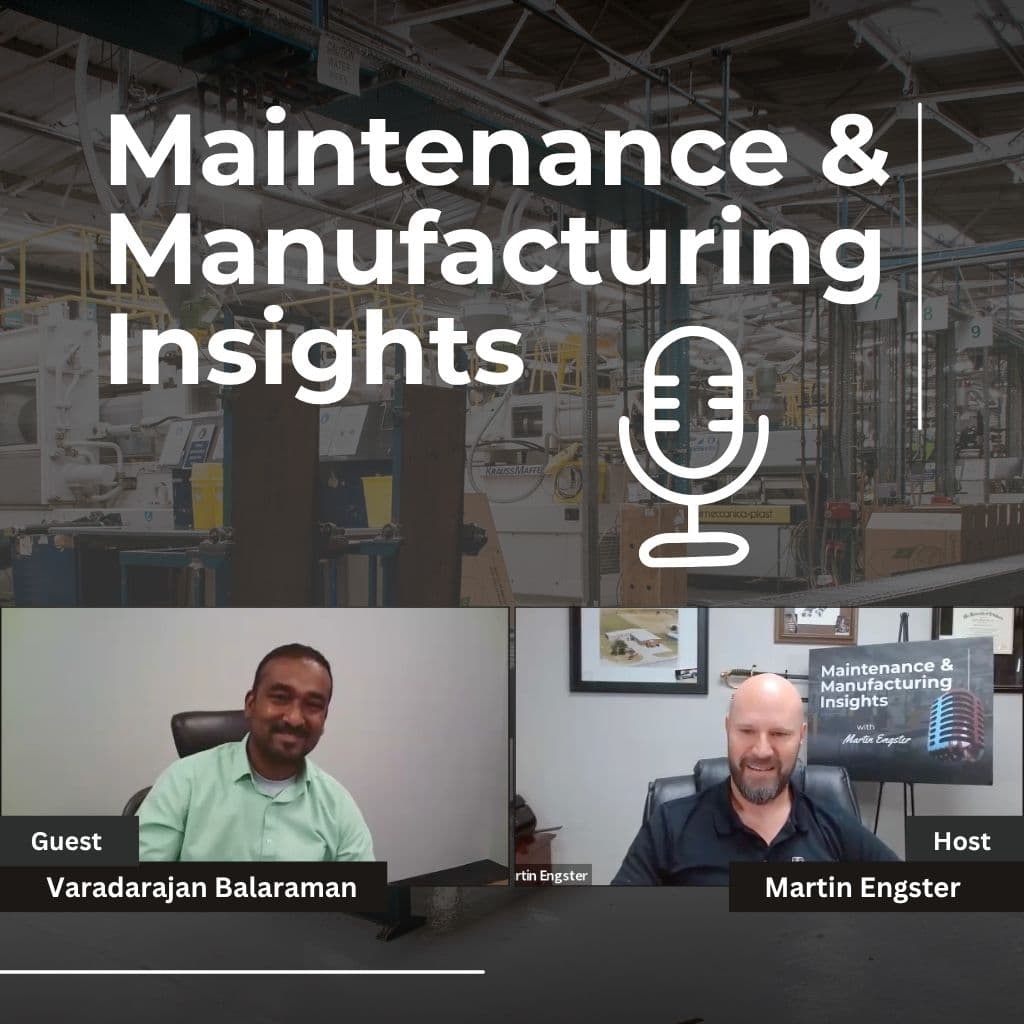
What does it take to build a manufacturing operation from the ground up while creating the maintenance systems needed to keep it running? I got to explore that question with Varadarajan "V" Balaraman on this episode of Maintenance & Manufacturing Insights. V is a site plant manager within Standex International, where he's helping build a startup manufacturing operation inside an established company — with responsibilities spanning operations, supply chain, revenue, profitability, equipment, processes, and team development.
Turning Failures Into Teachable Moments
One thing that stood out was V's approach to equipment failures. For V, getting a machine running again isn't the end of the job. The next question is: why did it fail?
He uses root cause analysis to look at people, machines, methods, materials, and the environment. When the team discovers something like a worn component, that knowledge becomes part of the preventive maintenance program — so the next failure can potentially be caught before it happens. That's how a breakdown becomes a teachable moment.
When Technology Reaches Its Limit
V shared a great example involving a robotic spray booth used to apply glue. Glue naturally creates maintenance challenges — it can cure inside hoses, valves, manifolds, and spray nozzles, leading to clogs and downtime.
V and his team first explored technical solutions. Eventually, though, they reached a point where technology alone wasn't going to eliminate the problem. That's when they turned to the process, developing new standard operating procedures to flush the system before introducing glue and again when production stopped.
I liked V's framing: first determine what technology can reasonably solve. Once you've reached that technical limit, look at how better processes and procedures can address what's left.
Listen to the People Closest to the Machines
Another important part of our conversation was communication. Operators work with the equipment every day — they may hear a strange noise or notice a small change long before anyone else does.
V is building systems where those observations don't disappear after someone mentions them to a busy supervisor. Instead, operators have a way to capture concerns so maintenance, supervisors, and plant leadership can review them and act.
For V, building a startup manufacturing operation is a lot like being an architect: you take something that can initially feel like a "jungle" and create an organized value stream, one problem at a time. And at the center of all of it is problem solving.
Watch & Listen
Give the full conversation with V a listen: